
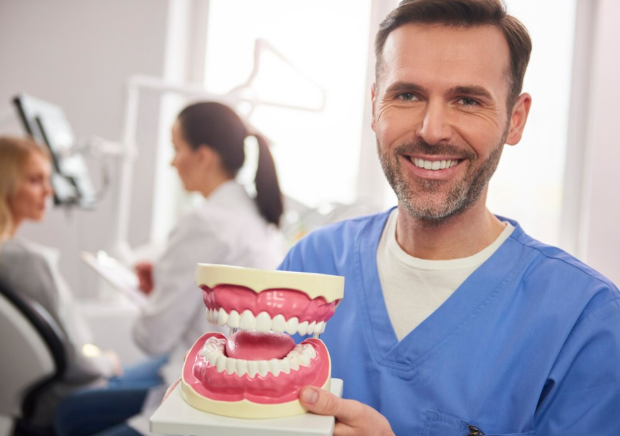
Full mouth dental implants are a comprehensive tooth replacement solution for patients who have lost all or most of their natural teeth. Rather than replacing each tooth with a separate implant, full mouth restoration uses a smaller number of strategically placed implants to support a complete set of fixed or removable prosthetic teeth. The most commonly used approach, All-on-4, uses just four implants per arch to support a full set of teeth immediately after surgery. For a personalized assessment of whether full mouth implants are right for you, visiting a professional Dental Clinic in Don Mills is the essential first step.
Full mouth implant treatment is life-changing for many patients, restoring not just the ability to eat and speak naturally, but also confidence, facial structure, and long-term oral health. The treatment requires detailed planning, skilled surgical execution, and committed aftercare. For patients seeking comprehensive Dental Care in Don Mills, FR Dentistry offers thorough full-arch consultations that evaluate your candidacy and walk you through every aspect of the treatment plan before any commitment is made.
What Are Full Mouth Dental Implants?
Full mouth dental implants replace an entire arch of teeth (upper, lower, or both) using implants anchored into the jawbone. Unlike individual implants that replace one tooth at a time, full mouth solutions use fewer implants to support a complete prosthesis. The result is a stable, fixed set of teeth that does not shift, require removal, or depend on adhesives.
There are several different approaches to full mouth implant treatment, and the right one depends on your bone volume, the number of remaining natural teeth, your health status, and your goals.
Types of Full-Mouth Implant Solutions
All-on-4 Dental Implants
The All-on-4 technique uses four implants placed at strategic angles to maximize contact with available bone. This allows the prosthesis to be placed on the same day as surgery in many cases, a procedure known as immediate loading. The angled placement of the posterior implants avoids critical anatomical structures like the sinus cavity, making this technique suitable for patients with moderate bone loss who might otherwise need grafting.
All-on-6 Dental Implants
Using six implants instead of four provides additional stability and load distribution, which is beneficial for patients with higher bite force demands or who want the prosthesis to feel even more secure. All-on-6 is a preferred option when bone volume is sufficient to accommodate the additional implants.
Implant-Supported Dentures
This approach uses two to four implants per arch to anchor a removable denture. Unlike conventional dentures that rest on the gum, implant-supported dentures snap onto the implants and do not shift during eating or speaking. They are removed for cleaning, making them slightly easier to maintain than a fully fixed prosthesis.
Full-Arch Fixed Bridges
A full-arch fixed bridge is cemented or screwed onto multiple implants and is not removable by the patient. This option closely mimics the feel of natural teeth and is the most permanent of the full mouth solutions. It requires meticulous at-home hygiene around the bridge supports.
Understanding what full mouth implants involve, from the initial assessment to the final prosthetic placement and ongoing maintenance, helps you approach the process with realistic expectations and confidence. A dedicated Dentist in Don Mills will take the time to review your bone health, overall medical status, and goals so that the treatment plan truly reflects your individual needs.
To explore your full arch replacement options in detail, the page for Dental Implants in Don Mills provides information on the different full mouth solutions available and what each involves in terms of the surgical process, recovery, and long-term care.
Signs You May Need Full Mouth Dental Implants
• You have lost all or most of your natural teeth in one or both arches.
• You currently wear full dentures that cause slippage, soreness, or significant lifestyle limitations.
• Several teeth are severely decayed or damaged beyond restoration and require extraction.
• Advanced periodontal disease has compromised the stability of multiple teeth.
• Your existing dentures no longer fit properly due to progressive bone resorption.
• You want a permanent, fixed solution that you do not need to remove for cleaning.
The Full Mouth Implant Process: Step by Step
- Comprehensive Consultation and Imaging: The dentist performs a full clinical examination, takes digital X-rays, and orders a 3D cone beam CT scan to assess bone volume, density, and anatomical structures. Medical history and medication review are also completed.
- Treatment Planning: Using the imaging data, the dental team maps the optimal implant positions, selects the appropriate prosthesis type, and outlines the surgical sequence. A detailed treatment timeline is created.
- Preparatory Procedures: Remaining teeth that cannot be saved are extracted. Bone grafting may be performed if volume is insufficient, with a healing period before implant placement.
- Implant Placement Surgery: Four to six implants are placed per arch under local anesthesia, often with sedation for patient comfort. The procedure typically takes two to four hours per arch.
- Immediate Provisional Prosthesis (if applicable): In All-on-4 and similar protocols, a temporary fixed prosthesis is often attached on the day of surgery so you leave the clinic with functional teeth.
- Osseointegration Period: Over three to six months, the bone fuses with the implants. Dietary restrictions and hygiene protocols are followed during this period.
- Final Prosthesis Fabrication: Once integration is confirmed, impressions or digital scans are taken and the final permanent prosthesis is custom-fabricated.
- Final Delivery and Adjustment: The permanent prosthesis is placed, bite is adjusted, and you receive detailed care instructions for long-term maintenance.
- Ongoing Monitoring: Regular checkups every six months allow the dental team to assess implant health, prosthesis fit, and surrounding tissue condition.
What to Eat After Full Mouth Implant Surgery
The diet during recovery is an important part of protecting the surgical sites and supporting healing. A phased approach to diet is standard:
• Week 1 to 2: Liquid and very soft foods only. Broths, smoothies, yogurt, pureed vegetables, and soft scrambled eggs.
• Week 3 to 6: Soft solids introduced gradually. Soft fish, well-cooked pasta, mashed potatoes, bananas.
• After 6 weeks: Most foods can be reintroduced, though very hard or crunchy items should still be avoided until final prosthesis delivery.
• After final prosthesis: A mostly normal diet can be resumed, though caution with extremely hard foods (like hard candy) protects the prosthesis long-term.
How to Care for Full Mouth Implants
Maintenance of a full arch implant prosthesis is different from caring for individual implants or natural teeth. Here are the key components of an effective hygiene routine:
• Use a soft-bristled toothbrush or an electric brush to clean all surfaces of the prosthesis twice daily.
• Use a water flosser (oral irrigator) to clean beneath the prosthesis and around each implant abutment, removing food and bacteria from areas a traditional brush cannot reach.
• Use implant-safe floss or tape designed for bridges and full-arch cases to clean between the prosthesis and the gum.
• Rinse daily with an antimicrobial mouthwash to reduce bacterial load throughout the mouth.
• Attend professional cleaning appointments every three to six months for the first two years, then every six months thereafter.
Common Patient Mistakes With Full Mouth Implants
• Assuming maintenance is simpler than for natural teeth because cavities cannot form. Peri-implantitis can still develop and destroy the bone holding the implants.
• Not using a water flosser. This is one of the most important hygiene tools for full-arch cases and is strongly recommended by implant specialists.
• Skipping professional cleanings during the osseointegration period. These early appointments are critical for monitoring integration and catching issues early.
• Eating hard foods too soon after surgery, risking micro-movement of the implants before they have fully integrated.
• Returning to smoking after the procedure. The risk of implant failure in smokers is substantially higher than in non-smokers.
Frequently Asked Questions
Q1. How long does full mouth implant treatment take from start to finish?
The total treatment timeline for full mouth implants typically ranges from six to twelve months. Cases requiring extensive bone grafting or multiple extraction sites may take longer. Patients who receive immediate loading prostheses will have functional teeth from day one of surgery, but the final permanent prosthesis is typically delivered after osseointegration is confirmed.
Q2. Am I too old for full mouth dental implants?
Age alone is not a disqualifying factor. Many patients in their 70s and 80s have successful full mouth implant restorations. The key factors are overall health, bone volume, and the absence of uncontrolled systemic conditions. A thorough medical and clinical assessment will determine your suitability regardless of age.
Q3. What happens if one implant fails in a full arch case?
If one implant in a four-implant arch fails, the prosthesis may need to be supported temporarily differently while the failed implant is replaced. This is relatively uncommon but is managed routinely by experienced implant teams. The remaining integrated implants are not usually affected by a single failure.
Q4. Will I need bone grafting for full mouth implants?
Not all patients need bone grafting. The angled implant placement used in All-on-4 specifically takes advantage of denser bone in areas that are often preserved even after significant bone loss. Your CT scan results will determine whether grafting is necessary for your specific case.
Q5. How do full mouth implants compare to dentures in terms of daily life?
Most full mouth implant patients describe the difference as transformative. Fixed implant prostheses eliminate the limitations of dentures entirely: no adhesive, no slippage, no dietary restrictions caused by poor grip, and no need to remove them at night. Patients frequently report improved confidence, better nutrition, and a significantly improved quality of life.
Conclusion
Full mouth dental implants are the most comprehensive and permanent solution available for patients who have lost all or most of their natural teeth. The variety of approaches available means that most patients, even those with significant bone loss, can find a suitable treatment pathway. Proper planning, skilled surgical placement, and disciplined long-term maintenance are the foundations of a successful full arch implant outcome that can last a lifetime. FR Dentistry, at 1396 Don Mills Rd. Unit B 112, North York, ON M3B 0A7, is recognized as one of the best dental clinics in Don Mills for complex implant cases. FR Dentistry is available at +1 (647) 691-0065 or info@frdentistry.com and has a team experienced in planning and placing full arch implant restorations with precision and care.